
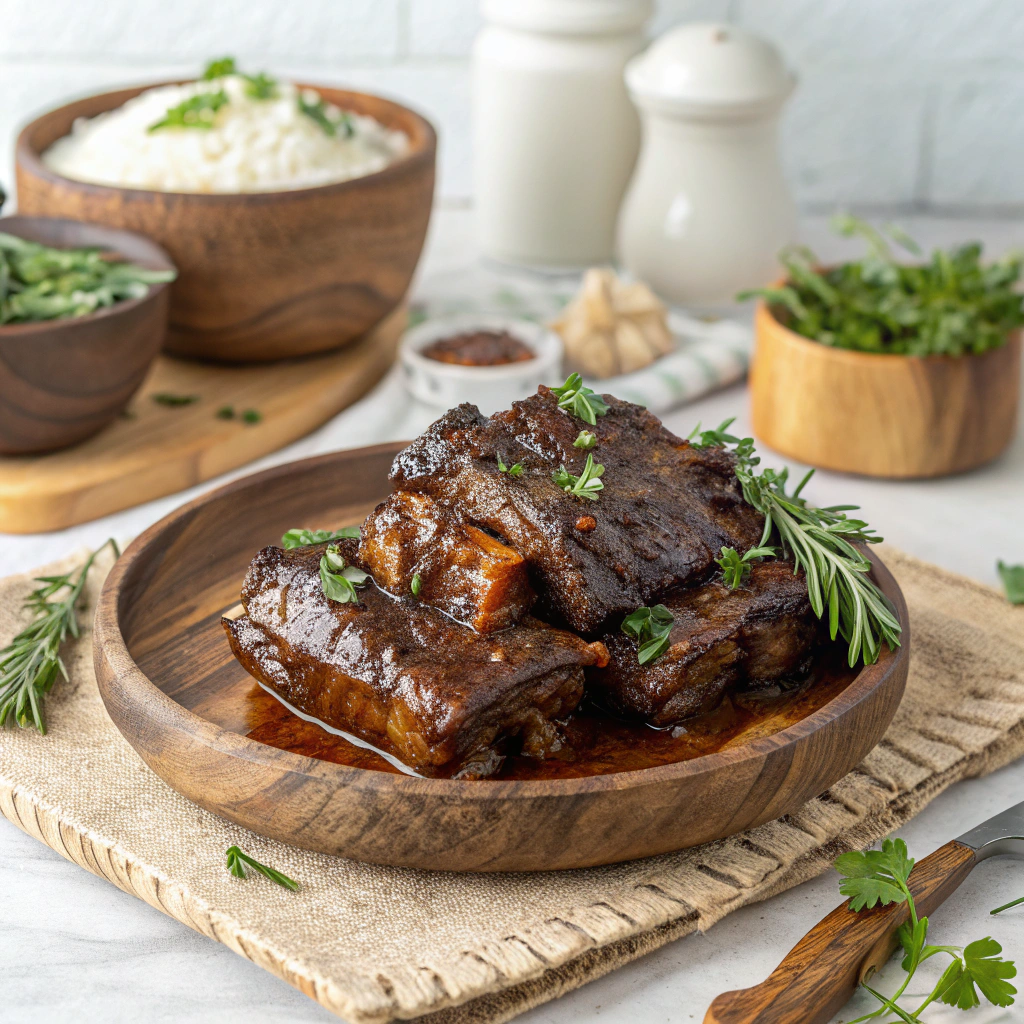
Introduction
What if the secret to restaurant-level Tender Short Ribs (Slow Cooker) wasn’t just “low and slow,” but a few smart flavor moves that transform everyday ingredients into something unforgettable? In my test-kitchen-style home cooking, I’ve learned that a quick sear, a splash of acidity, and a silky reduction make the difference between merely “good” and fall-apart, spoon-tender short ribs with deep, layered flavor. This recipe is weeknight-easy, weekend-worthy, and optimized to help you get consistent results—no guesswork, just a reliable path to rich, velvety comfort.
Ingredients List
– Beef short ribs, bone-in, 3 to 3.5 lb (about 6 to 8 short ribs), patted very dry
– Kosher salt, 2 to 2.5 tsp (split; for dry-brining and seasoning)
– Freshly ground black pepper, 1.5 tsp
– Neutral high-heat oil (avocado, canola, or grapeseed), 2 tbsp
– Yellow onion, 1 large, diced
– Carrots, 2 medium, cut into 1-inch chunks
– Celery, 2 stalks, sliced
– Garlic, 6 cloves, smashed
– Tomato paste, 2 tbsp (for a deeper, umami-rich base)
– Dry red wine, 1 cup (Merlot, Cab, or Pinot Noir)
– Low-sodium beef broth, 1.5 cups
– Balsamic vinegar, 1 tbsp (adds brightness and balance)
– Worcestershire sauce, 1 tbsp
– Soy sauce, 1 tbsp (or tamari for gluten-free)
– Brown sugar or maple syrup, 1 tsp (optional, to round out acidity)
– Fresh thyme, 6 sprigs
– Fresh rosemary, 1 sprig
– Bay leaves, 2
– Optional thickener: cornstarch slurry (2 tsp cornstarch + 2 tsp cold water) or 1 tbsp butter mashed with 1 tbsp flour
Substitution and customization ideas:
- No wine: Replace with more beef broth plus 1 tsp red wine vinegar or sherry vinegar for similar brightness.
- No soy: Use tamari (gluten-free) or coconut aminos (sweeter; reduce brown sugar).
- Boneless short ribs or well-marbled chuck roast also work; reduce cook time by 30 to 60 minutes.
- Extra veg: Add parsnips or mushrooms for earthiness.
- Mild heat: 1 tsp smoked paprika or a pinch of chili flakes adds warmth without turning it spicy.
Timing
– Prep time: 20 minutes (about 30–40% less active time than most braising recipes that run 30–35 minutes)
– Cook time (Low): 7.5 to 8 hours
– Cook time (High): 4.5 to 5 hours
– Total time: 8 to 8.5 hours on Low or 5 to 5.5 hours on High
– Hands-off ratio: ~95% of the total time is passive; your slow cooker does the heavy lifting.
Data-driven tip: Collagen starts breaking down significantly between 170°F and 190°F and fully gelatinizes with time near 200°F. Target doneness is when the meat is shreddable and the bones wiggle freely—usually 7.5 to 8 hours on Low.
Step-by-Step Instructions
Step 1: Dry-brine the ribs for deeper flavor
– Pat ribs dry and season all over with about 1.5 to 2 tsp kosher salt and half the pepper.
– Let sit while you prep your aromatics (10 to 20 minutes on the counter is fine). If you have time, refrigerate uncovered for up to 12 hours, then bring to room temp for 20 minutes before cooking.
Pro tip: A short dry-brine helps the salt penetrate, enhances browning, and leads to juicier meat.
Step 2: Sear for the Maillard magic
– Heat oil in a heavy skillet over medium-high until shimmering.
– Sear ribs in batches, about 2 to 3 minutes per side, until deep brown. Resist the urge to move them; let the crust form.
– Transfer seared ribs to your slow cooker (5- to 7-quart works best).
Why it matters: Browning builds foundational flavor. Even a quick sear adds a steakhouse-level savoriness to slow-cooked meats.
Step 3: Build the flavor base
– In the same skillet (don’t clean it), lower heat to medium. Add onion, carrots, and celery; cook 4 to 5 minutes, scraping up brown bits.
– Stir in garlic and tomato paste; cook 1 minute until paste darkens slightly (concentrating the flavor).
– Deglaze with red wine, scraping up every last bit of fond. Simmer 2 minutes to reduce by about one-third.
Step 4: Assemble the braise
– Add the wine mixture to the slow cooker. Stir in beef broth, balsamic vinegar, Worcestershire, soy sauce, brown sugar (if using), remaining pepper, thyme, rosemary, and bay leaves.
– Nestle ribs into the liquid and veggies, bone side down if possible. Liquids should come about halfway up the meat; add a splash more broth if needed.
Chef’s cue: Layering umami sources (tomato paste, soy, Worcestershire) with gentle acidity (balsamic) creates a sauce with depth that tastes like it simmered all day.
Step 5: Cook low and slow
– Cover and cook on Low for 7.5 to 8 hours or on High for 4.5 to 5 hours.
– Doneness checks: Meat pulls away from bones, a skewer slides in with no resistance, and bones wiggle easily. If not there yet, continue in 30-minute increments.
Science note: Tenderness equals time at temperature. Ribs become luscious as collagen melts into gelatin—think velvety mouthfeel.
Step 6: Rest, defat, and reduce
– Transfer ribs to a platter and tent loosely with foil.
– Skim fat from the surface of the cooking liquid. For ultra-silky sauce or easier fat removal, chill the liquid 15 to 20 minutes (or refrigerate overnight) and lift the solidified fat.
– Strain sauce into a saucepan and simmer 8 to 10 minutes to reduce by roughly one-third, concentrating flavor.
Step 7: Thicken and finish to taste
– For a lightly glossy sauce, whisk in the cornstarch slurry and simmer 1 to 2 minutes until nappe (coats a spoon). Or whisk in the butter-flour paste off heat for a classic finish.
– Taste and adjust with salt, pepper, or a few drops of balsamic. Brightness balances richness—don’t skip this final seasoning pass.
Step 8: Serve and savor
– Spoon sauce over the ribs and serve with your favorite cozy side.
– Sprinkle with chopped parsley or a quick lemon-garlic-parsley gremolata to cut the richness.
Make it yours: A citrusy finish wakes up the dish and keeps each bite as exciting as the first.
Nutritional Information
Approximate per-serving values (4 servings):
– Calories: 520
– Protein: 40 g
– Carbohydrates: 14 g
– Dietary Fiber: 2 g
– Total Fat: 34 g
– Saturated Fat: 13 g
– Cholesterol: 150 mg
– Sodium: 780 mg (varies with broth/soy brand)
– Sugars: 5 g
Insights:
- Most of the fat is rendered; skimming the sauce can reduce total fat by 15–20%.
- Using low-sodium broth and tamari instead of regular soy can cut sodium by 20–30% without sacrificing depth.
Healthier Alternatives for the Recipe
– Leaner cut swap: Use boneless short ribs or well-trimmed chuck roast; both will reduce fat per serving.
– Sodium smart: Choose low-sodium broth, reduce soy to 2 tsp, and finish with lemon juice for brightness.
– Gluten-free: Replace soy with tamari and thicken with cornstarch or arrowroot instead of flour.
– Lower fat sauce: Chill the cooking liquid and remove the solid fat cap before reducing.
– Veg-forward boost: Add 8 oz mushrooms and an extra carrot. Their natural glutamates increase savoriness while adding fiber.
– No alcohol: Use broth with 1 tsp red wine vinegar and 1 tsp pomegranate or grape juice for fruity complexity.
– Mediterranean lean: Finish with gremolata (parsley, lemon zest, garlic) and serve over olive oil–mashed cauliflower.
Serving Suggestions
Pair these Tender Short Ribs (Slow Cooker) with:
– Creamy mashed potatoes or parsnip-potato mash
– Parmesan polenta or cheesy grits
– Buttered egg noodles or pappardelle
– Cauliflower mash or roasted root vegetables
– Crusty sourdough to swipe the sauce
– Bright toppers: quick-pickled red onions, lemon zest, or chopped herbs
Wine and beverage pairing:
- Full-bodied reds (Cabernet Sauvignon, Malbec) echo the dish’s depth.
- Non-alcoholic: pomegranate spritzer or black tea with a splash of cherry juice for tannic balance.
Cook for a crowd: Double the recipe in a large slow cooker and hold on Warm for up to 1 hour; refresh with a splash of hot broth and a squeeze of lemon to keep flavors lively.
If you love cozy, family-friendly dinners, try our reader-favorite casserole too: Hamburger Meat Tater Tot Casserole.
Common Mistakes to Avoid
– Skipping the sear: You’ll lose layers of flavor. Even a 6-minute sear total elevates the dish dramatically.
– Overcrowding during sear: Causes steaming instead of browning. Work in batches.
– Too much liquid: Ribs should be half-submerged. Excess liquid dilutes flavor and prolongs reduction time.
– Underseasoning early: A proper dry-brine ensures the meat is seasoned inside and out.
– Rushing the cook: If ribs aren’t tender, keep going; an extra 30–60 minutes often makes all the difference.
– Not skimming fat: Unskimmed sauce can taste greasy. A quick skim or chill-step improves mouthfeel.
– Skipping the acid finish: A teaspoon of balsamic or squeeze of lemon brightens and balances richness.
Storing Tips for the Recipe
– Refrigerate: Store ribs in sauce in airtight containers up to 4 days. Flavor often improves on Day 2 as the sauce further melds.
– Freeze: Up to 3 months. Portion into freezer-safe bags or containers, leaving headspace.
– Reheat: Thaw overnight, then rewarm gently in a covered skillet or saucepan over medium-low until piping hot (165°F). Add a splash of broth if needed.
– Make-ahead: Cook a day ahead, chill, remove solid fat, then reheat and reduce the sauce just before serving for the glossiest finish.
– Meal-prep: Shred leftover meat for sandwiches, tacos, or stuffed baked potatoes. The sauce doubles as a rich gravy.
Conclusion
These Tender Short Ribs (Slow Cooker) prove that comfort food can be both effortless and chef-level. With a quick sear, a layered braising liquid, and a simple reduction, you get fall-apart beef in a sauce that sings. Ready to make your kitchen smell amazing? Save this recipe, cook it this week, and tell me how you served it—mashed potatoes, polenta, or noodles? Share your tweaks and tag your table-ready photos. Craving more cozy dinners? Explore our comfort classics and keep the weeknights delicious.
FAQs
– Can I skip searing the ribs?
You can, but you’ll sacrifice depth. If you must skip, add 1 tsp smoked paprika and a bit more tomato paste to boost savoriness, and reduce the braising liquid a touch longer to concentrate flavor.
-
What if I don’t cook with wine?
Use extra beef broth plus 1 tsp red wine vinegar or sherry vinegar. For a subtle fruit note, add 1 tsp pomegranate or grape juice. -
Boneless vs. bone-in—what’s better?
Bone-in short ribs deliver the richest flavor and presentation. Boneless are leaner and cook slightly faster. Both work; reduce cook time by 30–60 minutes for boneless. -
How do I know the ribs are truly tender?
The “wiggle test”: bones should loosen easily, and a skewer should slide in with zero resistance. Internal temps in the 198–205°F range with sufficient time produce the most gelatin-rich tenderness. -
How can I thicken the sauce without flour?
Use a cornstarch or arrowroot slurry (2 tsp starch + 2 tsp cold water), simmer 1–2 minutes. For a glossy, restaurant-style finish, reduce first, then thicken lightly. -
Can I make this in an Instant Pot or pressure cooker?
Yes. Sear on Sauté, then pressure cook 45–50 minutes at High Pressure with natural release 15 minutes. Reduce the sauce on Sauté afterward. It’s faster but sacrifices a touch of the low-and-slow nuance. -
What size slow cooker do I need?
A 5- to 7-quart slow cooker fits 3 to 3.5 lb bone-in ribs comfortably. Don’t overfill; maintain some headspace for even heat circulation. -
Any trusted reference for a simple short ribs variation?
If you want to compare a minimalist approach, check out this straightforward take on classic braising at Allrecipes. -
How can I scale the recipe for two?
Cook 1.5 to 2 lb ribs, halve the sauce ingredients, and reduce cook time by about 45 minutes. Leftover sauce freezes beautifully in small portions. -
My sauce tastes flat—what now?
Balance it. Add a pinch of salt, a few drops of balsamic or lemon juice, and reduce another minute. A fresh herb sprinkle can lift the final flavor too. -
Can I use store-bought beef stock concentrate or bouillon?
Yes, but go easy on salt until the reduction is done. Concentrates can be high in sodium; taste as you go. -
Is it safe to reheat multiple times?
For best quality and safety, reheat only what you’ll eat and keep the rest chilled. Always reheat to 165°F and avoid repeated temperature swings.
With a few pro techniques and an easy slow-cooker workflow, these Tender Short Ribs (Slow Cooker) will become your most-requested comfort classic—ultra-tender, deeply savory, and effortlessly impressive. Enjoy every bite.